 |
 |

News
Everyone needs to take responsibility for peace entrusted to them: Bishop of Clogher
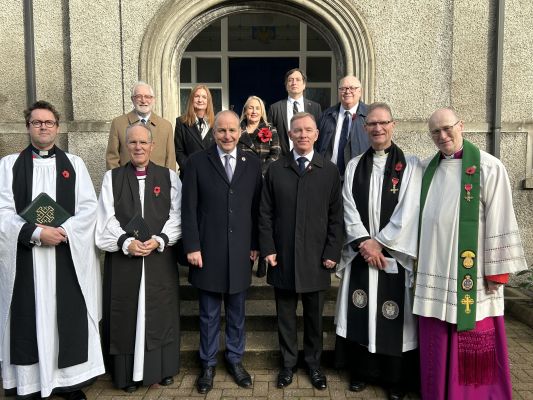
The government leaders and clergy who attended the Remembrance Service in Enniskillen.
The Bishop of Clogher, Right Revd Dr. Ian Ellis said we can honour those we remember by taking responsibility for the peace entrusted to us.
Giving the address at the Remembrance Service in St. Macartin’s Cathedral, Enniskillen this morning, Bishop Ellis quoted Jesus, ‘Blessed are the peacemakers: for they shall be called the children of God” (Matthew 5:9) and went on to say; “Peace is a fragile thing; it needs constant attention. We are to be not simply those who wish for peace, but those who work for it and make it, listening to one another and creating something together amid division and barriers.
“For the Christian, following Christ means putting that calling into practice; principled lives challenging hatred, seeking harmony and finding reconciliation, and caring for those wounded by war or conflict.”
Speaking at the service attended by the Secretary of State for Northern Ireland, Sir Chris Bryant M.P.; the Taoiseach, Michael Martin and representatives of the US, Canada, Poland and New Zealand governments, as well as His Majesty's Lord Lieutenant, Viscount Brookeborough, he said today’s Remembrance Service brought to their attention the sacrificial service of many from this town and district who died in two world wars of the early 20th century, conflicts across the world since and here in our province through its period of troubles.
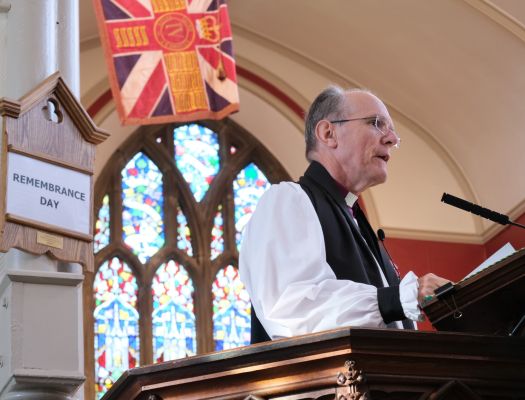
Bishop Ian Ellis preaching at the Remembrance Service.
“And on this day of all days, we recall the loss of life in this community in the atrocity of the Enniskillen poppy day bomb exactly 39 years ago. Remembrance of lives lost, selfless service that future generations might be free, wounds suffered and bravely borne in dark and difficult days.”
“When we fall silent on Remembrance Sunday, we all have different thoughts of remembrance - we remember lives cut short, families changed for ever, and those who came home from war carrying wounds that could not always be seen. We remember, too, the people who struggled to keep something human alive amidst war and conflict. In our own community, we reflect on families who lost loved ones whilst serving to protect us and who somehow have kept life going for one another and found light during their darkness.
“Recently while listening to the early morning Radio 4 news, I heard a lovely story from the second world war of an English soldier and musician; Alan Bolt.
“Captured by the Nazis whilst serving with the British Army in North Africa during the Second World War, he eventually found himself in a prisoner-of-war camp near Dresden, Germany. There were men there from different Allied countries. Some had musical instruments. Others had musical skills. Alan brought them together and amazingly in that camp formed an orchestra.
“Think of what that meant. These men could not choose where they lived. They could not choose when they would go home. They could make very few choices, but, within those terrible limits, they could play music and listen to one another. They could practise together. They could make something beautiful.
“During his time in the camp, he was summoned to the commandant's office and the commandant said, ‘we would like you to go to Dresden and conduct the Dresden state opera and their orchestra’. Of course, this was a tremendous thing, but Alan realised that it was a propaganda exercise, so he refused. A few days later he was summoned back and this time there was an SS officer sat in the at the chair and as Alan went in, the officer took his revolver out and pushed it on the desk in front of him and said, ‘what's all this nonsense about you not wanting to go to Dresden?’ but Alan stuck to his decision and refused to go; it was a high stakes choice but he survived. Despite extreme provocation he kept to his principled decision.
“Throughout the time in the camp, Alan arranged music for the instruments they had, and he composed music of his own. One work, a festival overture, was never played in the camp: liberation came before the orchestra could perform it. He brought the manuscript home and put it aside, but he died without hearing it played by a live orchestra.
“Years later, his widow brought that manuscript to the attention of the Royal Liverpool Philharmonic. The conductor worked on it, adapting the music for a modern orchestra while trying to remain faithful to what Alan had written. At last, music born in captivity could be heard in freedom. It was recently performed in Barrow in Cumbria.
“It truly was music stronger than war. Yet that does not make the suffering worthwhile. No beautiful piece of music can cancel the cruelty of war or repay the loss of a single life. But this story does speak of the resilience of the human spirit, the power of music and reminds us that cruelty need not have the final word.
“In that POW camp, the allied prisoners faced great brutality and hardship. They learned to lean on one another for support. That orchestra depended on people listening to one another’s instrument. Each player had a different part, but none could make the whole music alone. Perhaps there is something there for us to carry beyond today’s Remembrance silence.
“On an international scale the importance of nations working together for peace was recently referred to by Mark Carney the Prime Minister of Canada in a speech to the UN: ‘In this fragmented world, cooperation is not an ideal �' it is a necessity. No country, no matter how powerful, can manage these challenges alone’.
“Peace cannot be assumed and the norms of the post war we have largely enjoyed can no longer be taken for granted. That post-war order is eroding, and the underlying logic that justified multilateral cooperation is more compelling than ever. The climate emergency is intensifying, artificial intelligence is advancing rapidly, and armed conflicts are destabilising entire regions. Carney is pointing out that nations must continue to work together for peace.
“This week on television a young great grandson of Winston Churchill interviewed some veterans of the 2nd World War. He asked the 100 year old veterans: What was the message they gave from their experience of war? �' the answer was: ‘do everything you can to avoid war and seek peace. Nothing good comes from war’.
“In our own community we too cannot be complacent about peace and stability and we cannot afford to allow despair, frustration and dejection to deflect us from working together for better understanding to build a shared future. Here in Enniskillen, we are fortunate to have seen how harmonious community relationships can be built. We were all delighted recently when His Majesty honoured both the Dean and The Monsignor for their commitment to peacebuilding. That is an important acknowledgement of their work, but it also points to a continued effort on behalf of us all to build peace.
“Remembrance asks us to look back honestly and gratefully. It also asks how we will live now. Will we listen before we speak? Will we resist the language that injures and disrupts relationships? Will we make room for those whose lives have been broken by conflict? Are we willing to work together for peace?
“We cannot undo the past. But we can honour those we remember by taking responsibility for the peace entrusted to us.
“Alan Bolt made his music with the people and instruments he had. We, too, must begin with what is in our hands: our words, our choices, our neighbours, and our willingness to listen. These are the basics of peace-making.
“May our remembrance become more than a moments of profound silence. May it become a way of working and living in harmony with others and with God’s wonderful creation.”
Jesus said, “Blessed are the peacemakers: for they shall be called the children of God” (Matthew 5:9)
Closing prayer
God of peace, as we remember those who died in war or conflict, comfort all who mourn and all who bear its wounds. Teach us to listen, to resist hatred, and to seek reconciliation. Give us courage to be peacemakers, so that our remembrance may bear fruit in lives of love. Through Jesus Christ our Lord. Amen.
The hymns were 'Guide me O thou great Jehovah,' 'I vow to thee, my country,' 'Lord, while for all the world we pray,' 'Be thou my vision,' 'Nearer, my God, to thee, nearer to thee.' The praise was led by the Cathedral choir and Director of Music and organist, Mr. Glenn Moore.