 |
 |

News
Bishop addresses Clogher Diocesan Synod highlighting the need for new forms of ministry
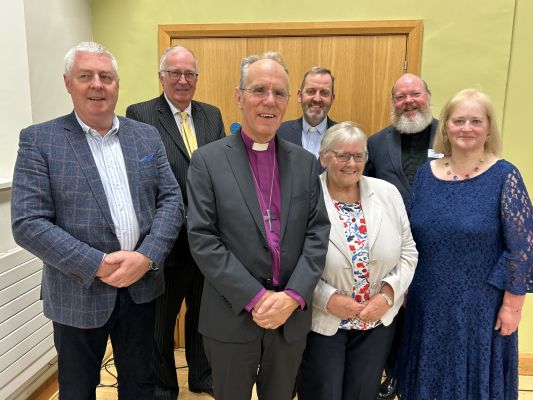
The Bishop of Clogher with those taking part in the Clogher Diocesan Synod.
The Clogher Diocesan Synod has taken place in St. Macartin’s Cathedral Hall, Enniskillen, with the Bishop of Clogher, the Right Revd Dr. Ian Ellis highlighting the need for sustaining ministry in parishes in the years ahead.
He said there has been a growing theme in much of the work in the Diocese in the past year; helping everyone to realise that ministry is broad in its scope and much greater than the work of ordained ministers.
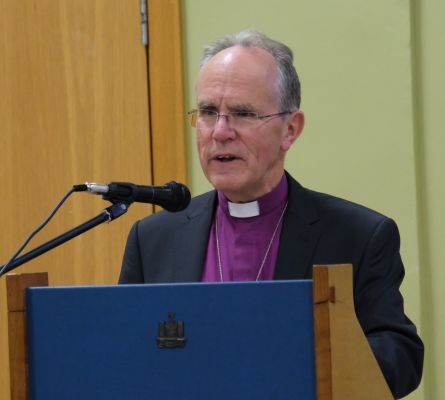
Bishop Ian Ellis addressing the Clogher Diocesan Synod.
“There is a specific vocation to ordained ministry and it has a specific liturgical, sacramental and pastoral role, however there are so many other ministries and gifts needed to enable the body of Christ to function and develop,” he told the Synod representatives.
Speaking about the work in Clogher Diocese, he said; “We have been developing this as we have held discussions in various vacant parishes about ways of sustaining ministry going into the future. We have begun to take seriously the presenting challenges of the context of our times; that is not so much a shortage of finance but a shortage of ordained clergy. There has been a reduction in recent years of people sensing a call to stipendiary ministry, therefore a smaller number in training and being ordained. This year there were eight ordinations in the Church of Ireland leading to curates feeding into the pool of clergy available to take up incumbencies in parishes right across Ireland.
“We must do something therefore to address this shortage of clergy. Part of this is to raise awareness of vocation and to present the thought to our laity that God may be calling you to ordained ministry. We have seen some modest uptake in this since we held our vocations evening last year: two of our parish readers have begun training for Ordained Local Ministry which is a recent development in the Church of Ireland.
“Earlier this year I was delighted to ordain Sarah Maguire from Rossorry Parish as a deacon OLM after she had completed her training, and she is continuing to work alongside her Rector Rev Stephen McWhirter. I am the bishop who leads the OLM oversight group which supervises the training of OLMs in the Church of Ireland Theological Institute. OLM is a growing ministry and increasing numbers are now coming forward sensing a call to this ministry. It enables lay people to train in a mix of online lectures and local learning hubs along with some Saturday sessions in Dublin at CITI.
“On completion of the course over two and a half years, they are eligible to be ordained and deployed in their local diocese by the bishop. It is a self-supporting ministry; they do not receive a stipend as stipendiary clergy do but receive modest support from the diocese for their travel and other costs in providing service cover.
“We are fortunate to have three OLMs in the diocese (Revs Abraham Storey, Colin Brownsmith and Sarah Maguire) and their contribution to ministry is invaluable.
“Another growing area is in Parish Readers; Canon Lorraine is our warden of readers and there are currently nine persons training to become parish readers. Some parish readers in time progress to become diocesan readers who are an invaluable resource for providing Sunday cover across the diocese especially at a time of many vacant parishes and giving clergy holiday cover too.
“Another aspect of addressing the shortfall in clergy able to take on incumbencies is to look at our parish structures.
“The Permanent Commission set up following our Diocesan review has been busy meeting with vacant parishes and looking to scope out the possibilities of sustaining ministry going forward. Given the clergy shortage and the changing patterns of life we have been looking at the potential for a team ministry approach and bringing parish groups together. The idea is to provide a ministry team of an incumbent, an OLM, diocesan reader, parish reader, DPA and others to work collaboratively to provide the ministry in that enlarged group.
“One advantage is that a wide variety of skills are available, it’s not just one man or woman and that finance could be released to enable a group administrator to be appointed and relieve the clergy from being deskbound and diverted from the essence of their calling which is pastoral ministry.
“We are at the early days of this, but our hope is that in a short while one new group might be able to advertise for an incumbent to be the team leader of a suitably resourced team. More to follow on this. The lesson we are learning is that the church will have to creatively enable all its gifts of ministry, equipping them; lay and ordained, to enable the body of Christ to build and grow as we heard in the vision of St Paul.
“In a recent Diocesan Magazine article, I discussed the theme of heritage in church life. We are fortunate in Clogher diocese to have a rich array of heritage assets. For many church members, the word “heritage” suggests visible signs of faith: a familiar tower on the skyline, the sound of church bells, a stained-glass window, a memorial tablet, or a churchyard where generations of parishioner’s earthly remains lie at rest. They tell us that there has been Christian witness within our towns, villages, and countryside for centuries, with many of our churches tracing their origin back to the period of early Celtic Christianity in Ireland.
“Caring for these assets is important and I am grateful for the sacrificial work of Select Vestries in their management of the fabric of the buildings we have care of. I am also grateful to the diocesan Architect, Rural Deans, Glebes Secretary, Property Assets Adviser, and Glebes committee in their regular routine work of inspections of churches and glebes constantly keeping maintenance and repairs to the fore in our parish life.
“Church heritage is also found in the rhythm of weekly worship. As we begin the cycle of church life after a summer break, we become aware that Sunday by Sunday, Scripture is read, prayers are offered, hymns are sung, and the sacraments are celebrated.
“There is, of course, a danger in treating heritage as if it belonged only to the past. Christian heritage is not a museum display. The Christian writer Michael Marshall during the decade of evangelism in the 1990s, came up with an arresting equation which he believes applies in church life: ‘Maintenance minus mission equals mausoleum!’ It amplifies the thought that the church constantly needs renewal and must action Jesus’s call to mission; go into all the world and make disciples…’. Marshall’s point is that if the church neglects its mission, it risks becoming a quaint artifact of history.
“The faith we have received is to be prayed, practised, taught, shared, and lived. Church buildings are most truly honoured when they continue to be places of welcome, worship, compassion, and mission. Traditions are most faithfully kept when they draw us more deeply into the Gospel and point us to reach out to serve the world God loves.
“So, heritage and renewal are not opposites. The Church is called to look back with gratitude and to look forward in faith, to be inspired by the saints of the past and reach out to the community today with the Good News of Jesus Christ.
“As I read the diocesan magazine, I am constantly amazed by the variety of parish life and the outstanding array of parish activities, outreach and imagination in doing new things. In a few week’ time I hope to come back to my former parish of Rossorry to dedicate and open their new parish Hall, office facilities and worship area built beside the church. This is a very exciting project and will provide a superb range of facilities to enable the parish to reach out into the community and parish in new ways. I congratulate the rector and Select Vestry on this achievement and their faith to invest resources into the future ministry of the parish. It is great to see this and other signs of growth and development of the heritage of the parish and diocese.”
Bishop Ellis went on to refer to changes in diocesan personnel with a new rector, Revd Rodney Magennis instituted in Monaghan group of parishes and in the past year, two clergy moving away; Revd Ian Cruickshank retiring from the Carrickmacross Group and Revd Mark Gallagher, formerly from Trory and Killadeas Parishes, moving to Drumglass Parish with two retirements at the end of September; Archdeacon Paul Thompson, Rector of Derryvullen Noth and Castle Archdale and Revd Alan Capper, Rector of Lisnaskea.
The Bishop paid tribute to the work of Archdeacon Paul Thompson highlighting his diligent and effective service to the diocese, sharing his skills and experience in so many ways and serving on many diocesan and central church committees.
He also named Archdeacon Thompson's successor, Canon William Jeffrey.
Bishop Ellis also referred to the retirement of Rev Alan Capper who had served as Rector of Lisnaskea since 2009 saying he had contributed much to the diocese and parishes he has served in.
The Bishop also paid tribute to several people who had served the Diocese in many ways, Mrs Una Bourke and Mr Robert Fyffe who had died in recent times.
Bishop Ellis thanked the Diocesan team and the honorary secretaries for all their work.
He also highlighted the significant changes to safeguarding and how they affect parishes.
#2
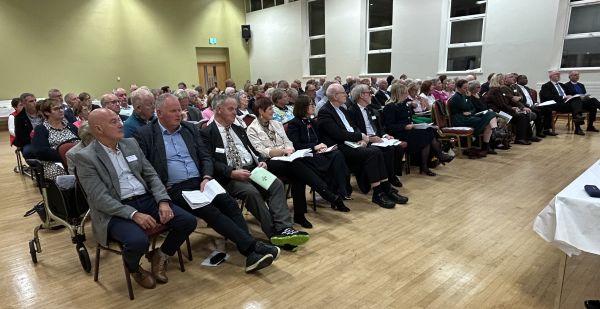
Parish representatives attending the Clogher Diocesan Synod.